The conversation around ERP in the Gulf has evolved significantly. About ten years ago, Odoo emerged as the flexible open-source alternative in regional tenders, often considered when legacy ERP licensing proved too costly for mid-sized contractors.
Today, that perception has shifted. Across sectors like contracting, engineering, and industrial manufacturing, Odoo stands on its own merits. They now evaluate it based on its functional depth, maturity in localization, and the availability of certified implementation experts in the region.
Odoo supports over 600,000 users in the Middle East and ranks as the 3rd most popular open-source software in Saudi Arabia.
These figures are important for different reasons. The large user base indicates a wealth of regional talent, including administrators, functional consultants, and developers who are already familiar with the platform. The ranking in Saudi Arabia shows that Odoo’s adoption extends beyond the UAE free zones into the Kingdom’s industrial sector.
Looking ahead to 2026, the question for MENA industrial enterprises isn’t whether Odoo can scale, but whether an implementation partner can configure it to meet both regional regulatory requirements and sector-specific operational needs.
Navigating Regional Compliance: VAT and Corporate Tax
Tax configuration is often where regional ERP projects encounter challenges. Deploying a global instance with default settings may yield accurate ledgers but non-compliant filings. In the UAE, Odoo’s VAT compliance hinges on the localization layer being properly installed, mapped, and validated according to Federal Tax Authority standards before any transactions occur. This proactive approach avoids retrofitting during the first filing cycle.
Once configured correctly, the accounting module manages key aspects:
- Tax Code Mapping: This includes standard-rated, zero-rated, exempt, and out-of-scope supplies, applied at the product and customer level to prevent manual entry errors.
- Reverse Charge Handling: Critical for contracting firms dealing with foreign subcontractors and equipment suppliers.
- FAF Generation: Produces the VAT audit file structure expected by regulators, using live transactional data instead of spreadsheet reconstructions.
- Corporate Tax Readiness: Involves analytic segmentation to derive taxable income per legal entity, track free zone status, and separate qualifying income from non-qualifying revenue streams.
- Multi-Entity Consolidation: Enables groups operating across UAE, Saudi, and Qatari registrations to maintain a unified reporting structure.
A tax structure designed without understanding Gulf regulations can lead to liabilities, which may only surface years later during audits when correcting transaction histories becomes impractical.
Solving Industrial Complexity in Contracting and Manufacturing
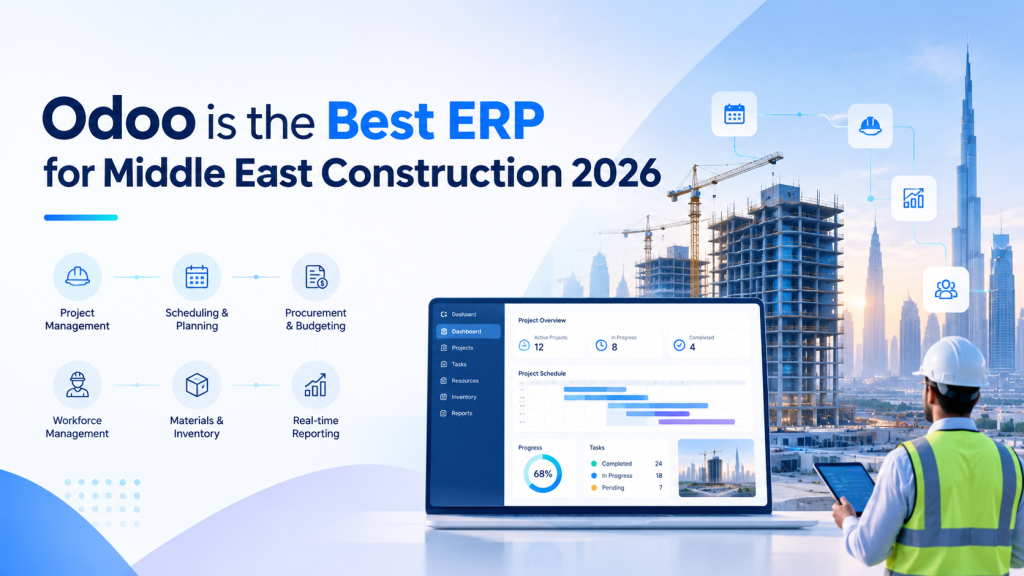
Contracting businesses operate not on orders but on long-term projects involving subcontractors and billing against certified progress. A generic ERP might force this into a sales-order model, losing the true financial picture. Odoo’s project and analytic accounting features allow contractors to track committed costs, actual costs, and revenue recognition per work breakdown element, providing project managers with early insights into margin erosion.
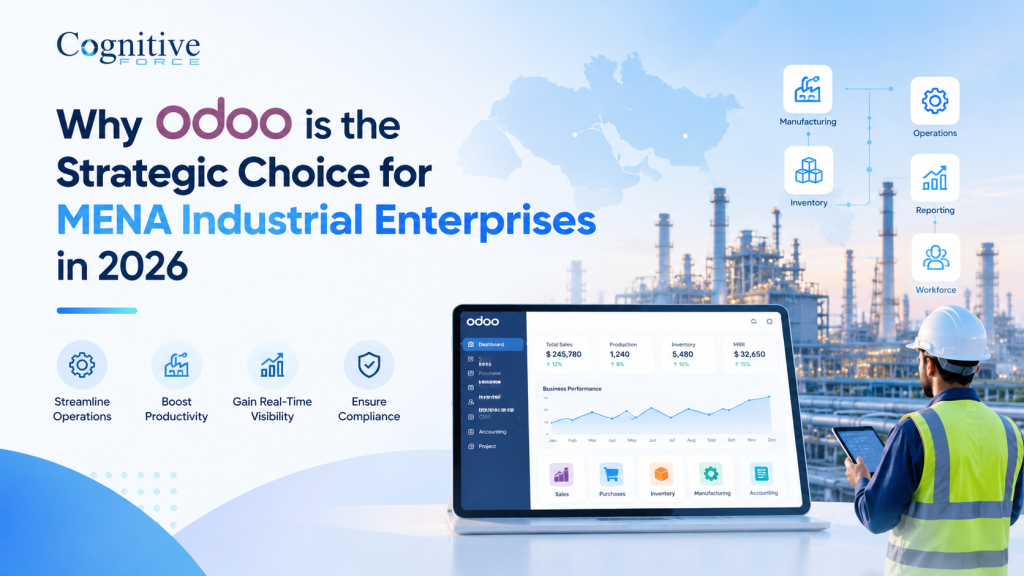
Manufacturing presents a different set of challenges. Regional plants often use mixed modes, combining make-to-order fabrication with repetitive production, while adhering to maintenance schedules tied to critical equipment. An ERP for Middle East manufacturing must integrate bills of materials, work center capacity, quality checkpoints, and preventive maintenance into a single data model. Odoo’s MRP, Quality, and Maintenance apps do this natively, eliminating the integration issues that arise from using separate systems.
Where transaction volumes are high and repetitive, such as in supplier invoice capture and delivery note reconciliation, RPA layered onto Odoo can handle the clerical workload, preventing headcount expansion as the business grows.
The Partner Ecosystem: Gold vs. Silver Tiers
Odoo typically does not implement its own software for enterprise clients. Instead, delivery is managed through an accredited partner network. The tier a partner holds is a crucial indicator for buyers before making a decision.
The hierarchy is based on certified consultant headcount and sustained project volume:
- Ready Partner: Entry-level accreditation, suitable for small deployments with limited customization and short timelines.
- Silver Partner: Demonstrates repeat delivery and has a certified team, making it suitable for mid-sized multi-module rollouts.
- Gold Partner: The highest tier, requiring extensive certified resources and a strong delivery record. Engaging an Odoo Gold Partner in Dubai is advisable for complex multi-entity industrial projects with tax intricacies and heavy customization.
This status is not merely symbolic. Accredited partners have direct escalation channels to Odoo, early access to release information, and a level of accountability that independent developers cannot offer. When a contractor’s project accounting faces issues mid-financial-year, having an escalation path becomes more crucial than the hourly rate.
Regional expertise is equally important. A partner experienced in configuring Gulf tax structures, handling Arabic-language invoicing, and managing free zone entity structures can deliver an Odoo implementation that MENA enterprises can rely on.
Always verify a prospective partner’s current tier directly on Odoo’s official partner directory before making a shortlist.
Infrastructure and Support: Odoo’s Dubai Presence
Many software vendors claim regional commitment, but few sign long leases. Odoo’s Middle East operations are firmly rooted in Dubai, with activities spanning the Dubai South (DWC) corridor and DMCC, chosen for strategic reasons. DWC aligns with logistics and industrial infrastructure, while DMCC offers commercial licensing and free zone structures typical of regional headquarters.
A facility of this scale isn’t just a sales outpost; it includes functional consultants, technical support staff, and training resources located in the same time zone as their customers. This arrangement enhances the practical experience of using Odoo in the Gulf, ensuring that support tickets raised in Riyadh or Doha are addressed promptly, not delayed by a European backlog. Escalations for critical production issues on manufacturing lines receive immediate attention.
The staffing commitment also strengthens the regional talent pool that partners draw from, accelerating the maturity of Odoo’s regional localization compared to markets relying solely on resellers. Local presence compounds benefits: more consultants, more deployments, and more edge cases resolved.
Summary: Key Takeaways for MENA Decision Makers
For executives evaluating platform options this year, five points are particularly significant:
- Odoo’s regional adoption is established, not emerging: With over 600,000 users across the Middle East and a top-three open-source ranking in Saudi Arabia, the platform has the installed base and consultant availability that enterprise procurement committees seek.
- Tax compliance is a configuration discipline, not a feature checkbox: VAT treatment, reverse charge logic, FAF output, and Corporate Tax segmentation hinge on correct localization setup before going live.
- Industrial fit comes from the shared data model: Integrating project accounting, MRP, quality, and maintenance within one database prevents the integration failures common in contracting and manufacturing deployments.
- Partner tier predicts outcome more reliably than price: Gold-tier accreditation reflects both certified resources and delivery history, the key factors in ensuring a complex rollout’s long-term success.
- Physical presence underwrites platform stability: A Dubai headquarters built for 600 people signals that regional support, training, and roadmap input are stable and reliable.
The decision-making process boils down to one question: Can the chosen partner deliver global ERP capabilities within the constraints of Gulf regulations?
Moving Toward a Unified Digital Future
The future of ERP in the region will not be defined by the number of modules, but by how much routine work, like invoice matching and cost allocation, can be automated. AI-assisted forecasting and RPA, when layered onto a well-structured Odoo foundation, make this shift feasible, as long as the data model is built correctly from the start.
This is why the implementation approach is as important as the platform choice. A sales-led engagement focuses on signatures, while a consultant-led engagement focuses on long-term sustainability, ensuring that the chart of accounts survives audits and project costs align with certified progress. Cognitive Force takes the latter approach, prioritizing process mapping over configuration, aligning regulatory requirements before modules, and tailoring solutions for the realities of contracting and manufacturing rather than relying on generic templates.
If your organization is considering migrating from a legacy ERP or recovering from a problematic implementation, the first useful step is to conduct a structured assessment of current processes against regional compliance obligations. Begin there before discussing licensing.
Frequently Asked Questions about Odoo in the MENA Region
Yes. When configured correctly by an experienced partner, Odoo handles all regional tax obligations. This includes UAE VAT mapping, FAF file generation, and KSA ZATCA Phase 2 e-invoicing integration. Compliance is a matter of proper localization setup during the implementation phase.
An Odoo Gold Partner represents the highest level of certification and experience. For complex industrial or manufacturing firms, this tier ensures you are working with a team that has a deep bench of certified consultants and a proven track record of handling high-stakes, multi-entity rollouts in the Middle East.
Absolutely. Odoo’s project and analytic accounting modules are ideal for contracting. They allow teams to track committed versus actual costs, manage subcontractors, and recognize revenue based on certified progress rather than simple delivery dates.
With its headquarters in Dubai, Odoo provides localized support within the same time zone. This means your critical issues are addressed during your working hours, and you benefit from a talent pool of consultants who understand the specific regulatory and commercial nuances of the MENA market.