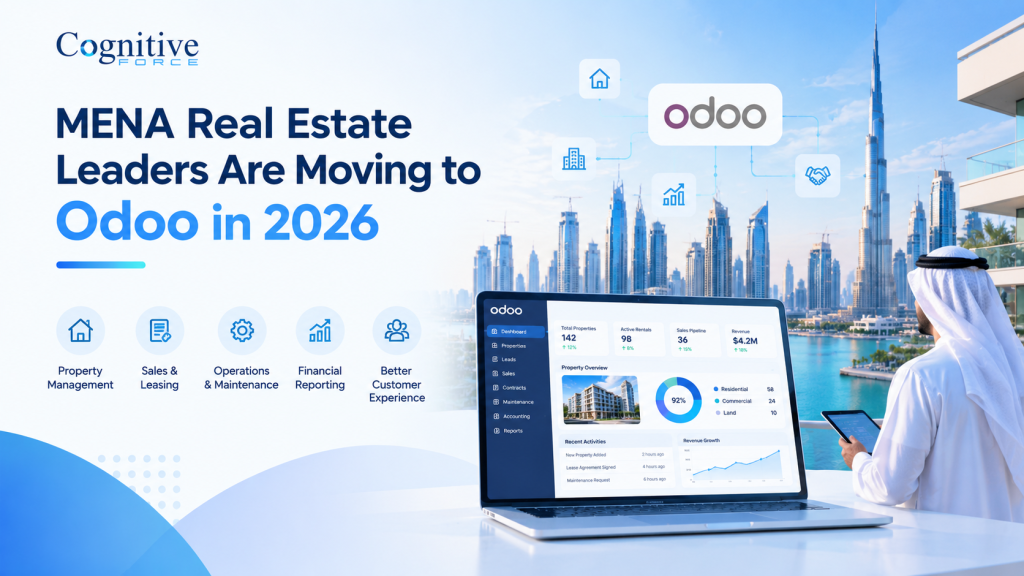
The Shift Toward Integrated Real Estate ERPs in 2026
Imagine you’re overseeing a mixed-use tower in Riyadh while collaborating with a contractor on its fit-out. Each team might be using entirely different software systems: one relying on a property management tool from 2017, another on spreadsheets paired with a standalone accounting package, and yet another on a leasing system that doesn’t integrate with the others. This fragmentation leads to inefficiencies and miscommunications. The current wave of ERP consolidation offers a solution that’s both economically viable and operationally necessary.
Approximately 58% of property management companies now operate on cloud-based systems. Marketing automation software has shown a 451% increase in qualified leads for real estate professionals. Integrated lease platforms, when paired with AI-generated marketing, reduce turnaround times and cut operating costs by 8-12%.
In the MENA region, the pressure is even greater. Regional regulators are tightening e-invoicing and tax reporting requirements, and developers are expanding across borders faster than their back offices can keep up. Odoo steps into this gap, not just as a cost-effective property tool, but as a comprehensive platform integrating construction management, leasing, and finance into one cohesive database.
Unifying the Property Lifecycle with Odoo Real Estate Modules
When we discuss Odoo for real estate, modularity is key. There’s no need for a one-size-fits-all property suite. Instead, you need CRM, inventory, accounting, and project management tools that all reference the same unit record from land acquisition through handover and into the lease cycle.
Listings and Lead Capture
Each property, floor, or unit is treated as a product record with specific attributes: area, orientation, fit-out status, and asking price. Whether inquiries come from your website, broker referrals, or walk-ins, they all land in the same pipeline. This allows your sales manager to see which units are attracting interest and which have been stagnant, without reconciling data from multiple sources.
Agreements and Contract Automation
Rental and sales agreements are generated from templates linked to the unit record, automatically pulling tenant details, payment schedules, and escalation clauses. This automation ensures invoices are posted on the agreed cycle, eliminating the common revenue leakage seen in multi-building portfolios.
Agent Performance and Commissions
Commission structures integrate into the same system that closes deals. Tiered rates, split commissions between internal agents and external brokers, and payout timing are all calculated against confirmed contracts. This gives management real-time visibility into the cost per closed unit rather than relying on quarterly reconstructions.
Maximizing ROI Through Marketing Automation and AI
The financial benefits of consolidation are most apparent on the demand side. Marketing automation software boosts qualified leads by 451% for real estate professionals. This is crucial for firms selling high-ticket inventory, where even one additional qualified conversation can justify the platform’s annual cost.
With automated nurture sequences responding to brochure downloads within minutes, serious buyers are routed to senior agents rather than sitting in a queue. Segmentation ensures that campaigns are targeted correctly, preventing off-plan villa promotions from reaching commercial tenants.
By 2026, AI-generated marketing assets, such as listing copy and multilingual campaign variants, will be standard features. These tools reduce the cost per acquisition by eliminating the need for agency retainers for each launch phase and filtering out unqualified traffic before it reaches an agent.
Operational Efficiency: Cutting Costs and Turnaround Times
The real savings come from eliminating duplicate work, not reducing headcount. Integrated lease platforms and AI-generated marketing cut operating costs by 8-12% and reduce turnaround times. Across a portfolio of thousands of units, these savings typically exceed the entire cost of implementation within the first full cycle.
Tenant onboarding provides a clear example. In a fragmented system, a signed lease might trigger manual entries into various systems. In a unified MENA property management ERP, the signature automatically creates the invoice schedule, asset assignment, and ledger entry.
Eliminating these bottlenecks:
- Re-keying tenant and unit data across systems
- Manually chasing lease renewals
- Tracking maintenance requests by email without SLA visibility
- Performing deposit and escalation calculations outside the ledger
- Reconciling subcontractor billing and project cost centers
- Resolving commission disputes due to inconsistent contract versions
Each of these issues represents a handoff, which translates to delays and potential errors. An integrated system simply has fewer of them.
Addressing the MENA Context: Compliance and Scalability
Generic property software from North America or Europe often treats regional requirements as an afterthought. MENA firms face e-invoicing mandates, VAT regimes that vary by jurisdiction, and Arabic-language documentation requirements. These aren’t just reporting features; they’re structural necessities that determine legal validity.
Compliance in this region isn’t optional. An ERP that can’t produce compliant documents natively accumulates liability with every transaction. Scalability is another regional pressure point. A developer might start with a single leasing agency and, within a few years, expand to include a contracting arm, facilities management subsidiary, and cross-border project company. Odoo’s structure allows these entities to share master data while maintaining separate books, enabling quick and efficient account consolidation.
The success of implementation hinges on the approach taken. A sales-led setup might configure modules based on a demo script, but a consultant-led engagement maps the chart of accounts, approval hierarchy, and regional tax logic to your business’s actual operations before users are trained.
Key Takeaways for Real Estate Digital Transformation
For decision-makers evaluating Odoo real estate 2026 against existing platforms, consider these points:
- Cloud is now standard. Approximately 58% of property management companies are already using cloud-based systems, making on-premise tools the minority.
- Automation impacts the top line. Marketing automation software increases qualified leads by 451%, emphasizing lead quality over volume.
- Integration eliminates duplication. Integrated lease platforms and AI-generated marketing cut operating costs by 8-12% and improve turnaround times, with savings scaling with portfolio size.
- Regional fit is crucial. E-invoicing mandates, multi-jurisdiction VAT, and Arabic documentation requirements make MENA compliance a configuration challenge that generic international deployments often overlook.
These points shift the evaluation focus. The question isn’t whether an Odoo real estate module can replicate existing systems, but how much margin is lost in the gaps between those systems.
Navigating Your Odoo Migration Strategy
Migrating from a legacy tool like Buildium isn’t just about data export. The real challenge lies in the unwritten logic: how renewals are approved, subcontractor retention is managed, and commission splits are applied. This knowledge often resides with operations staff, and a migration that doesn’t capture it will recreate old bottlenecks in new software.
Future-proofing adds another layer. Robotic process automation can handle repetitive reconciliation tasks, and AI-assisted workflows can draft listings, triage maintenance tickets, and score inbound leads. These technologies deliver value only when built on clean, unified data, making integration the first priority.
Choosing a migration partner should focus on regional expertise, not just certifications. Ask about their experience with e-invoicing in your jurisdiction, multi-company consolidation for contracting groups, and change management for teams accustomed to long-standing systems. Any Odoo real estate tutorial can show you the screens, but a consultant-led transformation configures the system around how your business actually earns money. Transforming your real estate operations requires more than just new software; it requires a partner who understands the MENA landscape. At CognitiveForce, our consultants work directly with you to ensure your Odoo implementation is compliant, scalable, and built for 2026. Book a free Odoo for real estate demo with our experts today.
Frequently Asked Questions
What is Odoo’s role in real estate management?
Odoo offers an integrated suite of applications that streamline real estate management, covering everything from CRM to leasing and finance.
How does the Odoo real estate module benefit property managers?
The module centralizes data, automates contract management, and integrates financials, enhancing efficiency and reducing errors.
Is there an Odoo real estate tutorial available?
Yes, there are tutorials and training materials available to help users navigate the Odoo real estate module effectively.
Can Odoo accommodate MENA-specific property management needs?
Absolutely. Odoo is designed to handle MENA-specific requirements like e-invoicing, VAT compliance, and Arabic documentation.
What makes Odoo suitable for property management in 2026?
Odoo’s adaptability, modular structure, and integration capabilities make it a future-proof choice for evolving real estate markets.
How does Odoo support real estate businesses in Riyadh and Dubai?
Odoo supports businesses by integrating regional compliance features and offering scalability for expanding operations in these markets.
What is unique about the Odoo real estate module?
Its modular design allows for customization and integration across various business functions, ensuring a tailored fit for real estate needs.
How can Odoo’s ERP system improve property management in MENA?
Odoo’s ERP system enhances operational efficiency, ensures compliance, and supports scalability, crucial for the dynamic MENA market.
What advancements are expected in Odoo real estate by 2026?
By 2026, Odoo is expected to incorporate more AI-driven features and enhanced automation for even greater efficiency in real estate management.
How do I start using Odoo for real estate management?
Begin by consulting with an expert to tailor the system to your business needs, ensuring a smooth transition to Odoo’s platform.